NIELIT Certificate vs Private Diploma: What Employers Actually Check
What makes a NIELIT certificate different from an unaccredited private diploma, how employers actually verify them, and how to choose a course wisely.
When two candidates walk into an interview holding what look like similar "computer diploma" certificates, the person doing the hiring is not just looking at the paper — they are, often without saying so, asking who stands behind it. This is the real difference between a NIELIT certificate and a diploma from an unaccredited private institute, and it matters more than most students realise when choosing where to study.
What NIELIT Actually Is
The National Institute of Electronics and Information Technology (NIELIT) is an autonomous scientific society under the Ministry of Electronics and Information Technology (MeitY), Government of India. It grew out of the earlier DOEACC Society, which for decades ran the standardised O, A, B and C level computer courses recognised across the country. NIELIT does not just train students directly — it also authorises and monitors training centres, sets the syllabus, conducts the actual examinations centrally, and issues the final certificate itself. The training centre or institute where a student studies is only the classroom; the exam and the certificate come from NIELIT's own examination system.
How This Differs From an Unaccredited Private Diploma
A private computer institute that is not affiliated with NIELIT, a university, or any other recognised body can still teach useful, practical skills — many do. But when it issues its own "diploma" certificate, that certificate is only as credible as the institute's own name and reputation, because there is no outside examination body, no government recognition, and usually no central database an employer can check against.
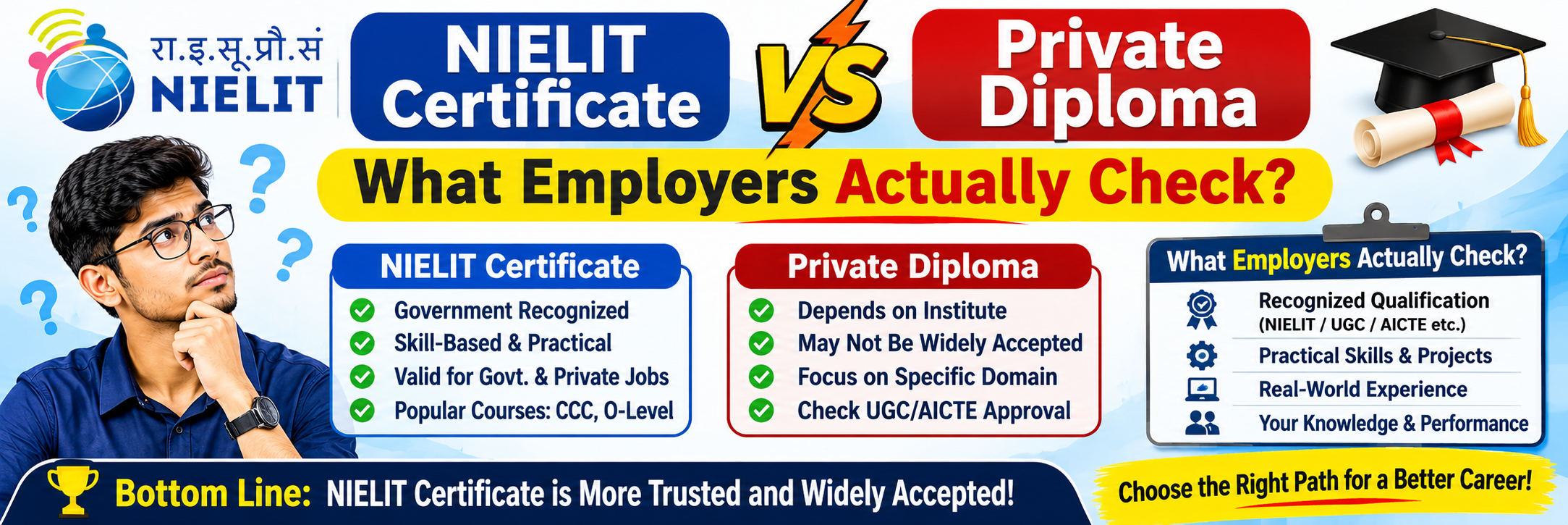
- Who conducts the exam: With NIELIT courses, the examination is set and conducted centrally by NIELIT, not by the local coaching centre. With an unaffiliated private diploma, the same institute that taught the course also tests and certifies the student.
- Recognition by government and institutions: NIELIT's O-Level and other level courses have, over the years, been referenced in various government circulars and recruitment notifications as equivalent to certain formal qualifications. A private, unaffiliated diploma generally carries no such standing.
- Verifiability: A NIELIT certificate carries a roll number and registration details tied to a central examination record, which can be checked against NIELIT's own records. A private diploma's authenticity can usually only be confirmed by calling the issuing institute directly.
- Consistency of syllabus: Because NIELIT sets one syllabus nationally, a CCC or O-Level certificate means roughly the same thing wherever it was studied. Private diplomas vary widely in content and rigour from one institute to the next, even when they use similar-sounding names.
How Employers and HR Teams Typically Verify Certificates
Verification rigour depends heavily on where you are applying. Government departments, public sector units, and compliance-conscious private employers are the most likely to actually check a certificate rather than simply accept it at face value.
Common Verification Approaches
- Asking for the examination roll number or registration number printed on the certificate, which can be cross-checked against the issuing body's own records.
- Checking whether the certifying body is one the employer or department already recognises, such as NIELIT, rather than researching an unfamiliar private institute from scratch.
- In some cases, contacting the certifying body directly to confirm a candidate actually appeared for and passed the exam in question.
- For many ordinary private-sector jobs, informal trust: HR may simply judge the certificate by whether they have heard of the issuing organisation before.
This last point is exactly where an unaccredited private diploma can quietly lose out — not because the training behind it was necessarily poor, but because the certificate gives the employer nothing independent to check.
A certificate is only as useful as the trust someone outside the classroom is willing to place in it — and that trust is far easier to establish when a recognised examination body, not just the teaching institute, stands behind the paper.
What This Means When Choosing a Course
None of this means every unaffiliated private institute is a poor choice, or that every NIELIT-affiliated course guarantees a job. But for a student trying to decide where to invest time and course fees, a few practical checks are worth making before enrolling.
- Ask directly whether the certificate at the end of the course is issued by the institute itself or by an external examination body such as NIELIT.
- If a certifying body other than the institute is named, verify independently that this body actually exists and conducts the course being described — do not rely only on the institute's own claims.
- Ask to see a sample certificate and check what details it carries, such as a roll number, registration number, or examination date, which indicate an external, verifiable process.
- If the goal is a specific government job that lists a named certificate like CCC or O-Level in its eligibility criteria, make sure the course you are considering actually leads to that exact certificate, not a similarly named one from a different body.
- Where possible, talk to past students who have already tried to use the certificate for a job application or admission, and ask what happened when it was checked.
Where YDR Foundation Fits In
YDR Foundation's CCC, DCA, ADCA and O-Level courses are designed to build exactly these foundational skills for students from underserved communities, with the added advantage of being tied to a recognised examination structure rather than an in-house certificate alone. For students from rural and economically weaker backgrounds, who often cannot afford to make an expensive mistake by enrolling in the wrong course, this distinction between an accredited certificate and an unaccredited diploma is one of the most practical pieces of information they can have before choosing where to study.