
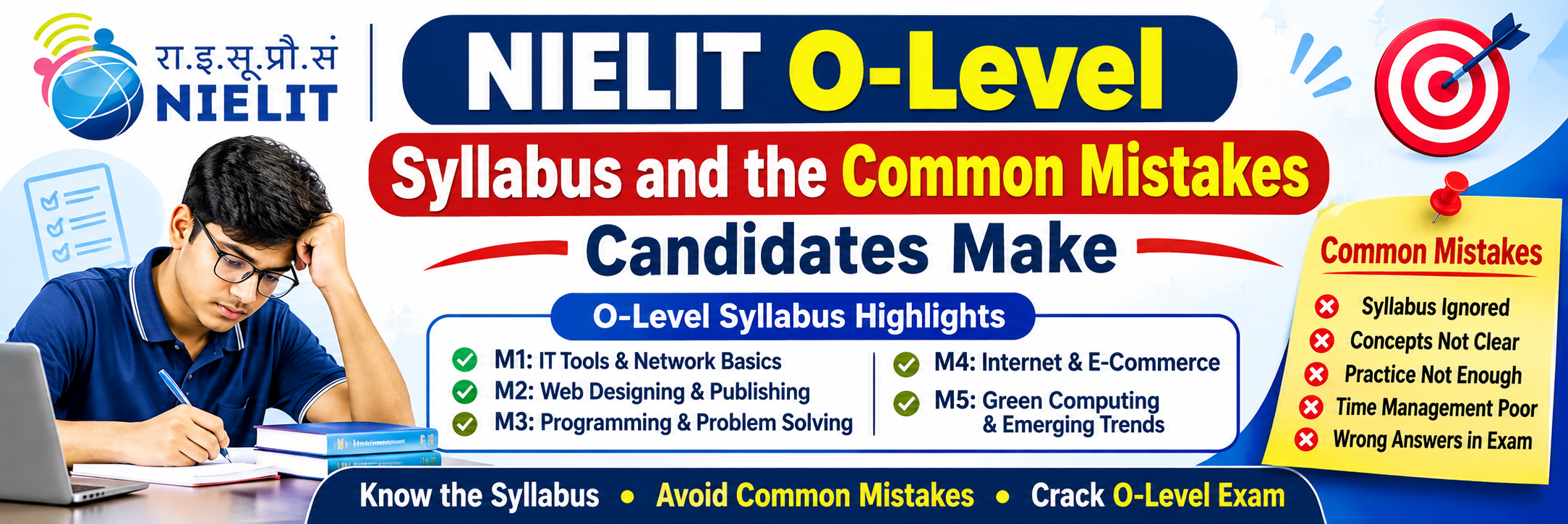
NIELIT O-Level Syllabus and the Common Mistakes Candidates Make
A practical look at the NIELIT O-Level course structure and the recurring mistakes candidates make in theory prep, practicals, and the project viva.
What the NIELIT O-Level Course Actually Covers
The O-Level course, conducted under the National Institute of Electronics and Information Technology (NIELIT), is a foundation-level IT programme recognised across India as an entry point into computer applications. It is often the first formal IT qualification a student takes after finishing the CCC or basic computer literacy stage, and it carries more weight than CCC because it combines theory, practical labs, and a project component assessed through a viva. Many students treat it as "just another computer course," which is exactly the mindset that leads to avoidable mistakes.
Broadly, the syllabus is organised around a few recurring pillars that show up across most NIELIT O-Level study plans:
- IT tools and business systems — covering office productivity software, operating system basics, and general digital literacy that a working professional is expected to know.
- Programming and problem solving — an introduction to logical thinking, flowcharts, and a programming language, which builds the base for later diploma-level or degree-level computer courses.
- Web design fundamentals — basic structure and styling of web pages, which gives students their first exposure to how websites are actually built.
- A practical project and viva — where the candidate builds something (commonly a small website or application) and defends it in front of an examiner.
The exact names of papers and the weightage can change across versions of the syllabus, so candidates should always cross-check the current structure on the official NIELIT portal before planning their study schedule, rather than relying on old notes passed down from a previous batch.
Mistake One: Memorising Instead of Understanding
The single biggest mistake candidates make is treating the theory papers as something to be memorised the night before the exam. NIELIT's question patterns are designed to test applied understanding, not just recall of definitions. A student who has memorised what a "variable" is but never actually written five lines of working code will struggle the moment a question is phrased differently from the textbook example.
The fix is simple but requires discipline: treat every theory topic as something you should be able to explain in your own words and, where relevant, demonstrate on a computer. If a topic cannot survive being explained out loud to a friend, it has not been understood yet — it has only been read.
Mistake Two: Ignoring the Practical Project Until the Last Week
Because the project and viva are weighted separately from the theory papers, many candidates underestimate how much time a decent project actually needs. A project that is assembled in the final week usually looks exactly like what it is — rushed, shallow, and difficult to explain convincingly in the viva.
Examiners in a viva are not primarily checking whether the output "works." They are checking whether the candidate understands what they built. Common red flags that examiners notice immediately include:
- Code or design copied from an online tutorial that the candidate cannot explain line by line.
- A project scope so large that basic functions do not work reliably, versus a smaller project that works cleanly from end to end.
- No awareness of why a particular tool, tag, or structure was chosen over an alternative.
- Inability to answer simple follow-up questions like "what would happen if you changed this value?"
A small, fully understood project defended confidently will almost always score better than an ambitious project the candidate cannot explain.
Mistake Three: Weak Hands-On Practice With Actual Tools
O-Level is explicitly a hands-on qualification. Candidates who only read about spreadsheets, word processors, or web page structure — without actually opening the software and practising — tend to freeze during the practical exam when asked to perform a task live. Reading about how to insert a formula in a spreadsheet is not the same as being able to do it under time pressure.
A practical routine that works well is to set aside dedicated lab time, separate from theory revision, where the only goal is to physically perform tasks: formatting a document, building a simple formula-driven spreadsheet, writing and running a short program, or laying out a basic web page. Repetition on the actual tools builds the kind of muscle memory that no amount of reading can replace.
Mistake Four: Not Reading the Latest Official Syllabus and Exam Instructions
NIELIT periodically updates its course structure, paper names, and exam conduct rules. Candidates who prepare from outdated material, forwarded PDFs, or hearsay from previous batches sometimes discover on exam day that the pattern they studied for is not quite the pattern being tested. Before starting serious preparation, always verify the current syllabus, eligibility, and exam format directly from the official NIELIT source, and re-check it again closer to the exam date in case of updates.
Building a Realistic Preparation Plan
A workable preparation plan for O-Level generally balances three things in parallel rather than doing them one after another: theory revision, hands-on tool practice, and early, steady work on the practical project. Candidates who separate these into sequential phases — "finish theory, then do practicals, then start the project in the last week" — are the ones who most often run out of time for the part that is hardest to rush: genuine, explainable project work.
- Start the project concept within the first few weeks of the course, even if it is simple.
- Practise on real software weekly, not just before the practical exam.
- Revise theory by explaining concepts aloud or teaching a classmate, not just by re-reading notes.
- Do a mock viva with a teacher or senior student at least once before the actual exam.
This kind of foundational, hands-on computer education is exactly what YDR Foundation's CCC, DCA, ADCA and O-Level courses are built around for students from rural and economically weaker backgrounds. Rather than treating certification as a one-time exam to clear, YDR Foundation's programmes are designed to build the kind of practical, explainable computer skills that hold up in a viva, in further study, and eventually in the workplace. For many first-generation learners in the communities YDR Foundation serves, this structured, patient approach to building real understanding — rather than last-minute memorisation — can make the difference between a certificate that sits in a file and a skill that is genuinely usable.