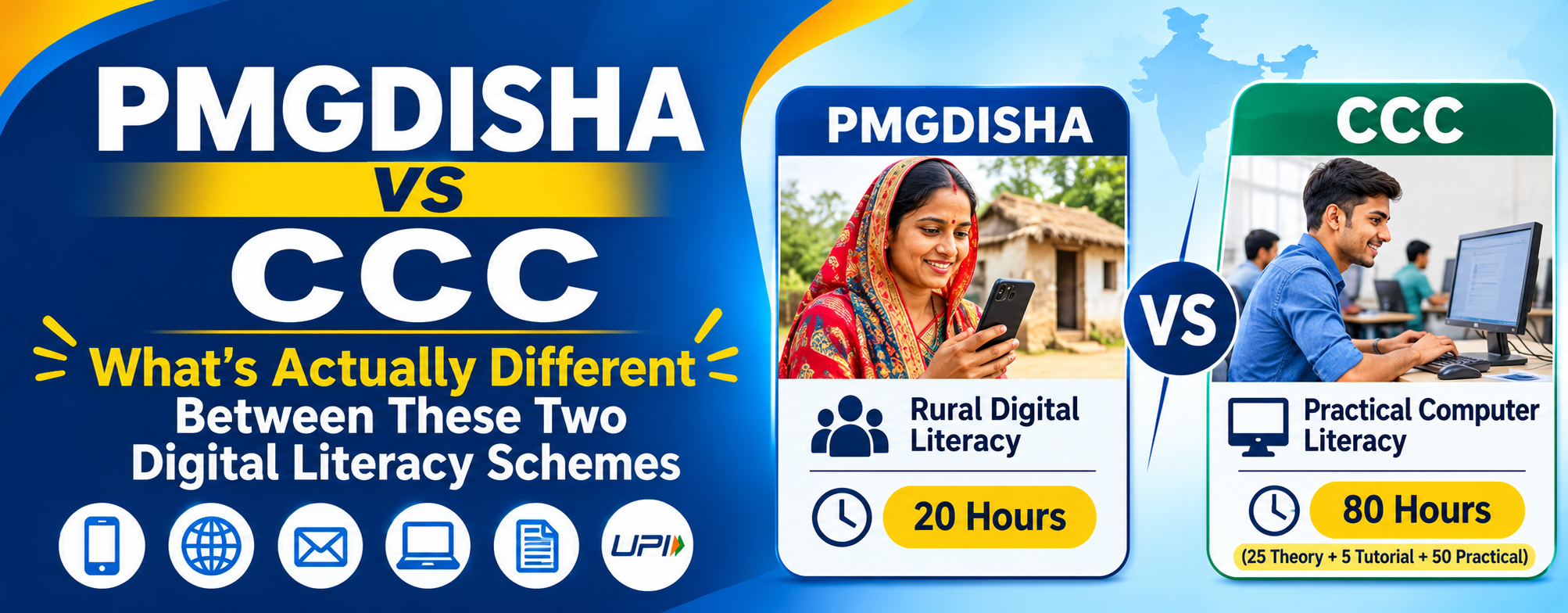
PMGDISHA vs CCC: What's Actually Different Between These Two Digital Literacy Schemes
A clear comparison of PMGDISHA and the NIELIT CCC course: depth, certification value, target audience, cost, and which one to choose for your goal.
Ask around a village or small town about "computer courses" and you will often hear both names in the same breath — PMGDISHA and CCC — as if they were interchangeable. They are not. One is a short, government-run digital literacy drive aimed at getting a basic level of comfort with a digital device into as many rural households as possible. The other is a structured, examined certification course that carries real recognition value for jobs and further study. Confusing the two leads to real disappointment — either someone expecting a job-ready certificate from a short literacy drive, or someone paying for a longer certification course when all they actually needed was basic familiarity with a smartphone.
What PMGDISHA is
The Pradhan Mantri Gramin Digital Saksharta Abhiyan (PMGDISHA) is a scheme run under the Ministry of Electronics and Information Technology, with the specific goal of making at least one person in every eligible rural household digitally literate. It is delivered largely through Common Service Centres (CSCs) set up in villages and small towns, and the training itself is short — generally designed to be completed over a limited number of hours spread across a few days — covering genuinely basic skills such as switching on and operating a digital device, understanding the internet, sending and receiving an email, using a mobile phone to access useful information and government services, and understanding basic digital safety.
PMGDISHA is best understood as a literacy drive rather than a vocational course. Its purpose is to reduce the number of people who have never touched a computer or smartphone, not to produce job-ready computer operators.
What CCC is
The Course on Computer Concepts (CCC) is a certification offered under the National Institute of Electronics and Information Technology (NIELIT), an autonomous body under MeitY. Unlike PMGDISHA, CCC is a structured course with a defined syllabus, a fixed course duration considerably longer than a literacy drive, and a formal examination that a learner must pass to be awarded the certificate. The syllabus goes well beyond basic familiarity, covering computer fundamentals, operating systems, word processing, spreadsheets, presentations, internet and email use, and an introduction to digital financial tools and e-governance services, among other topics.
Because it is examined and centrally administered by NIELIT, a CCC certificate carries a level of formal recognition that a basic literacy completion certificate does not. It is commonly accepted by various government departments and recruitment processes as valid proof of basic computer proficiency where such a requirement is specified, and it also functions as a stepping stone toward more advanced, longer courses such as DCA (Diploma in Computer Applications) or ADCA (Advanced Diploma in Computer Applications).
The real differences, side by side
- Depth: PMGDISHA covers basic operation and awareness; CCC covers a full structured syllabus with genuine depth across applications and concepts
- Duration: PMGDISHA is a short-duration programme; CCC runs over a considerably longer course period
- Certification value: PMGDISHA's completion certificate documents that basic literacy training was completed; CCC's NIELIT-issued certificate is widely recognised as formal proof of computer proficiency, including for several government eligibility requirements
- Target audience: PMGDISHA specifically targets rural households as part of a literacy mission; CCC is open to anyone seeking a recognised qualification, rural or urban
- Cost: PMGDISHA is generally free or heavily subsidised for eligible rural households under the scheme; CCC is a paid course with an associated examination fee
- Typical next step: PMGDISHA graduates who want more should move on to a proper certification course; CCC graduates who want more typically progress into DCA or ADCA
Basic comfort with a touchscreen and a recognised certificate that gets you shortlisted for a job are two different achievements — a learner should know which one they actually need before choosing a course.
A common misunderstanding worth clearing up
A fair number of learners and even some local training centres treat PMGDISHA and CCC as roughly the same thing at different price points, or assume that finishing one automatically counts toward the other. They don't connect that way. PMGDISHA was never designed with an examination-based, nationally standardised syllabus behind it the way CCC was, so there is no formal process by which PMGDISHA hours get credited toward CCC. A learner who has completed PMGDISHA and then enrols in CCC is, in effect, starting a new course from its own beginning — the earlier exposure certainly helps with confidence and basic familiarity, but it does not shorten the CCC syllabus or exempt the learner from any part of its examination.
This is worth knowing before enrolling anywhere, since some training providers are not always clear about the distinction, and a learner who expected a shortcut can end up frustrated partway through a CCC course that assumes no prior exemption at all.
Which one should you actually choose
The right choice depends entirely on the goal:
- If you or someone in your household has genuinely never used a computer or smartphone and simply needs to become comfortable with basic digital tasks, and your household is eligible under the scheme, PMGDISHA is the appropriate starting point
- If you need a certificate that will be recognised for a government job application, recruitment process, or further study requirement, PMGDISHA alone will not be sufficient — you need CCC
- If you have already completed basic literacy (through PMGDISHA or otherwise) and want to build toward real employability, CCC is the logical next step, and DCA or ADCA beyond that for deeper skills
- If you are starting from zero and are unsure, there is no harm in beginning with basic familiarity first and then enrolling in CCC once you are ready for a structured, examined course
Where YDR Foundation fits in
This is precisely the gap YDR Foundation's course offerings are structured around. Its CCC, DCA, ADCA and O-Level courses are built for learners from rural and economically weaker backgrounds who need something more substantial and more widely recognised than a basic literacy certificate — a genuine, NIELIT-affiliated qualification that can actually be shown to an employer or cited in a government recruitment process. For a student who has only ever had the kind of brief exposure a programme like PMGDISHA provides, a structured CCC course is often the realistic next step toward turning basic comfort with a device into an actual, usable skill.